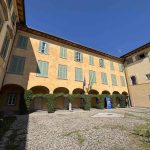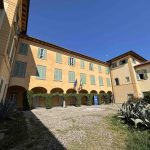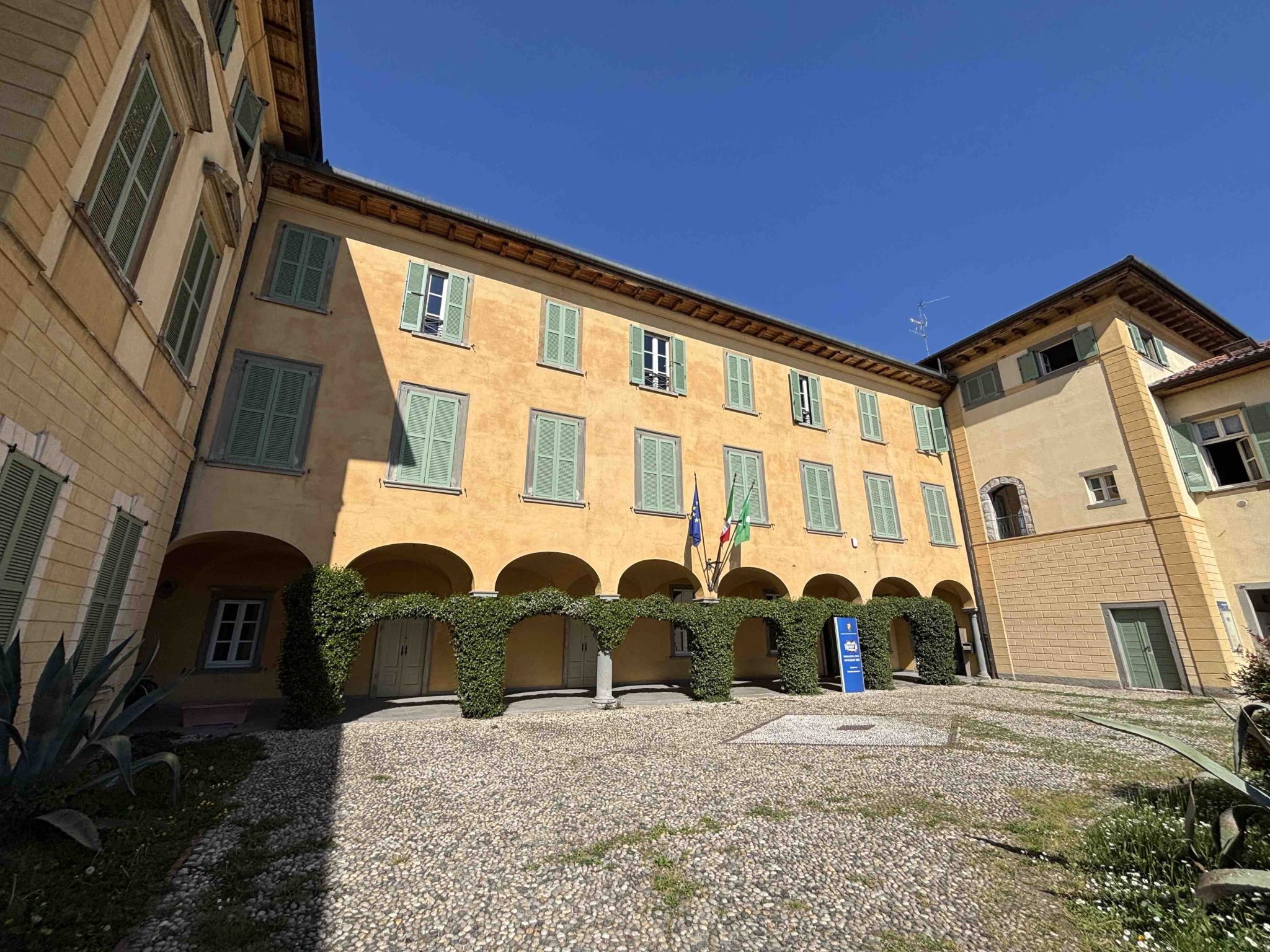
The complex known as “Le Stanze”, a national monument since 1932, is situated in the southern part of Trescore, where the ancient village of Bazago once stood.
Its origins, like those of the surviving neighbouring ancient buildings, are lost in the mists of time, leaving traces of the ramparts of an ancient medieval castle that belonged to the Lanzi family for a long time. During the period of conflict between the Guelphs and Ghibellines, between the 14th and 15th centuries, the castle suffered several raids and acts of destruction.
During the 16th century, the Lanzi family ceded part of the complex to other prominent local families, who adapted the medieval structures to the tastes of the time. In the mid-18th century, perhaps already a country villa, the entire building came into the possession of the Giovanelli di Gandino family, who carried out a radical transformation of the palace. In accordance with the layout most commonly used for stately homes at the time, the building took on a U-shaped plan. The Sarnico stone columns, as well as the existing section, were largely preserved and incorporated into the new villa.
In the eastern part, a chapel dedicated to the Immaculate Conception was built and consecrated in 1777. The structures of the ancient castle became the service quarters of the new villa, housing the peasants’ dwellings, stables and storehouses. Two new porticoes with three large arches were added to these. Between the two wings of the villa, on the southern side, a large balustrade supports the embankment that borders the courtyard.
At the rear of the building, a large area was transformed into an elegant park with avenues and ornamental plants. In the first half of the 19th century, further rustic outbuildings were added to the main building on the northern side. Following the extinction of the Giovanelli di Trescore family, the Stanze were purchased by the Swiss-born de Gonzenbach family to establish a spinning mill there, and the small chapel inside was converted into a gatehouse. The mill, which employed several dozen women, continued to operate until around the 1930s. Finally, at the beginning of the 20th century, the de Gonzenbachs constructed the large fountain basin within the courtyard. Since the 1980s, the complex has been owned by the local council and, in addition to the library, houses various public services.
Text by Luisa Gaiardelli and Carlo Pinessi
INFO:
– For further information, please contact the Department of Culture on +39 035955671, or the Trescore Pro Loco at +39 035944777