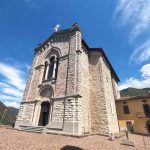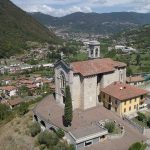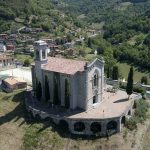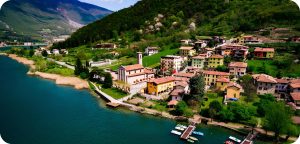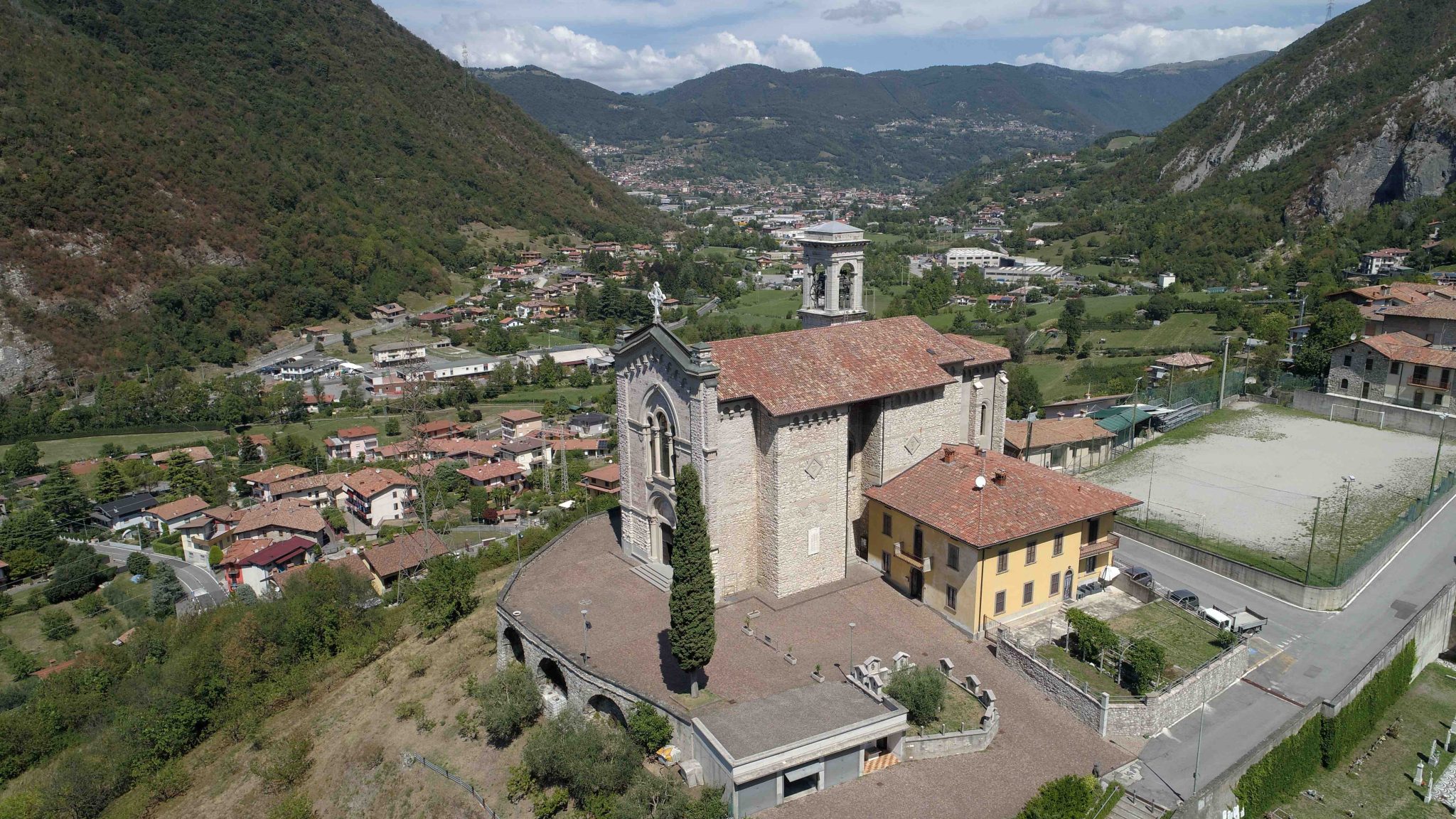
Designed by engineer Dante Fornoni, the church stands out for its elegant Neo-Gothic style and the harmony of its proportions, made all the more striking by the airy panoramic terrace on which it stands. A place that captivates from the very first glance, where architecture and landscape blend in perfect harmony.
The exterior is characterised by an elegant cladding of local stone blocks in delicate shades of white and pink, which lend the building a sense of brightness and refinement. The decorative and structural elements, such as arches and columns, were crafted with great skill by Pietro Monzio Compagnoni, helping to define the elegance of the entire complex.
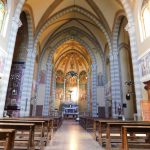
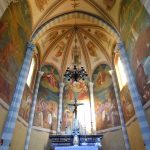
Inside, the church comprises a single, spacious nave divided into four bays, marked by half-columns and pillars that soar upwards, transforming into the ribs of the pointed arches. The cross vaults amplify the sense of verticality and spirituality, creating an intimate and solemn atmosphere.
In the second and fourth bays, there are two side chapels on each side, each with an altar, whilst the third bay houses the side entrances, which lend balance and harmony to the architectural layout.
The chancel, with its rectangular plan and raised five steps above the nave, naturally draws the eye towards the striking semicircular apse, the spiritual heart of the church and the culmination of the entire artistic and liturgical journey.
HISTORICAL NOTES:
– 1950: the fresco decorations on the walls of the polygonal apse are the work of the artist Arturo Muzio Compagnoni.
– 1470 – 1924: Grone’s status as an independent parish dates back to 1470. Its old church, built near a fort and rebuilt in 1710, was demolished in 1924 to make way for the new one;
– 1782 – 1964: the old bell tower was raised in 1782. Four bells from Santo Stefano degli Angeli, which had been modelled by Natale Mainoni of Milan and cast by the Locatelli family of Bottanucco in 1763, were replaced by the Paolo Capanni firm of Castelnovo de Monti with the current set of five bells in ‘mi gr.’, consecrated by Archbishop Clemente Gaddi on 8 September 1964;
– 1924 – 1928: the new church was designed by engineer Dante Fornoni and completed in 1928 by the Giacomo Carrara firm of Endine Gaiano;
– 1930: the church was consecrated on 24 November 1930 by Flaminio Belotti, Bishop of Sufetula, who dedicated it to Santa Maria Nascente and placed the relics of Saints Valeriano and Pio in the altar table of the high altar.
Source: “Le chiese delle diocesi italiane” https://chieseitaliane.chiesacattolica.it/chieseitaliane/index.jsp