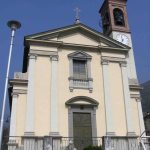
The parish church opens onto a spacious churchyard that enhances its visual impact: a remarkable space, extended on the south side and paved with regular local stone slabs, whilst on the other sides it alternates between cobbled sections and asphalted areas.
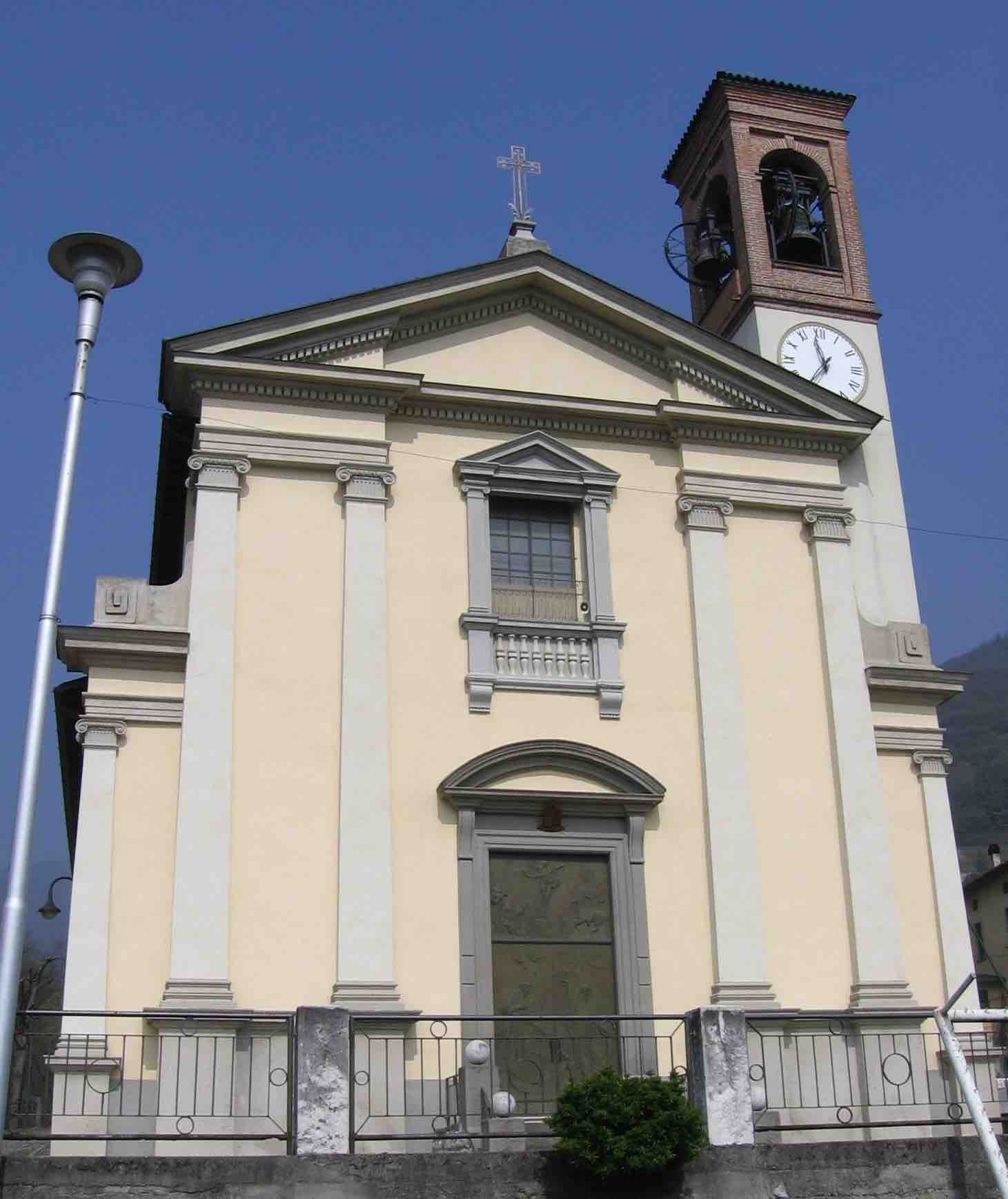
The main façade, facing south, stands out for the elegance of its architectural design. It is divided into three sections by four full-height pilasters which, resting on a high plinth of artificial stone, support an entablature adorned with Ionic capitals. In the central section, the entablature is interrupted, giving greater vertical height to the upper window, which serves as the base for the façade’s concluding pediment. Flanking the central section are two slightly recessed volumes, also delimited by similar pilasters and crowned by an entablature complete with frieze and cornice, connected to the main façade by elegant corbels.
At the centre of the façade, raised six steps above the churchyard, stands the main entrance portal, carved from solid sandstone. The moulded jambs and lintel, together with the corbels supporting the curved tympanum, lend the whole structure a great sense of refinement. Above the portal is a loggia window, also in sandstone, which illuminates the interior nave.
Upon passing through the entrance, which is closed by a bronze door and preceded by a walnut doorframe, one enters a cosy and harmonious interior space consisting of a single nave. The walls connect with curved lines to both the façade and the triumphal arch. Stucco pilasters, with Corinthian bases and capitals, divide the nave into three bays: the central bay, which is narrower, houses the side entrances, whilst the others contain two chapels on each side.
Above the capitals runs an entablature with a frieze and a walkable cornice, which serves as the impost for the barrel vault extending the entire length of the nave. Natural light, in addition to entering through the façade window, filters through the openings situated above the cornice in line with the side chapels, creating a bright and solemn atmosphere.
The chancel, which is slightly narrower than the nave and raised by three steps, has a square plan and is also covered by a barrel vault, illuminated by two further windows. The space is concluded by a semi-octagonal apse.
The entire decoration of the church is characterised by its simplicity: a sober and restrained choice, designed to highlight the light and harmony of the architecture, accompanied by discreet pictorial decoration.
HISTORICAL NOTES:
– 1936: completion of the façade, which had remained unfinished until then;
– 1859: during his pastoral visit on 22 February 1859, Bishop Mons. Speranza ordered the parish priest to extend the old church built in the 16th century;
– 1882: the parish priest, Don Angelo Scotti, decided, with the Bishop’s consent, to build a new church rather than extend the old one, which had become too small;
– 1887: on 5 May 1887, Bishop Gaetano Camillo Guindani laid the foundation stone of the church to be built;
– 1893: on 17 September 1893, the church was consecrated by Bishop Guindani himself and dedicated to St Bernardino of Siena;
– 1929–1931: work on the interior decoration: new stucco work and decorations;
Source: “Le chiese delle diocesi italiane” https://chieseitaliane.chiesacattolica.it/chieseitaliane/index.jsp