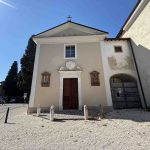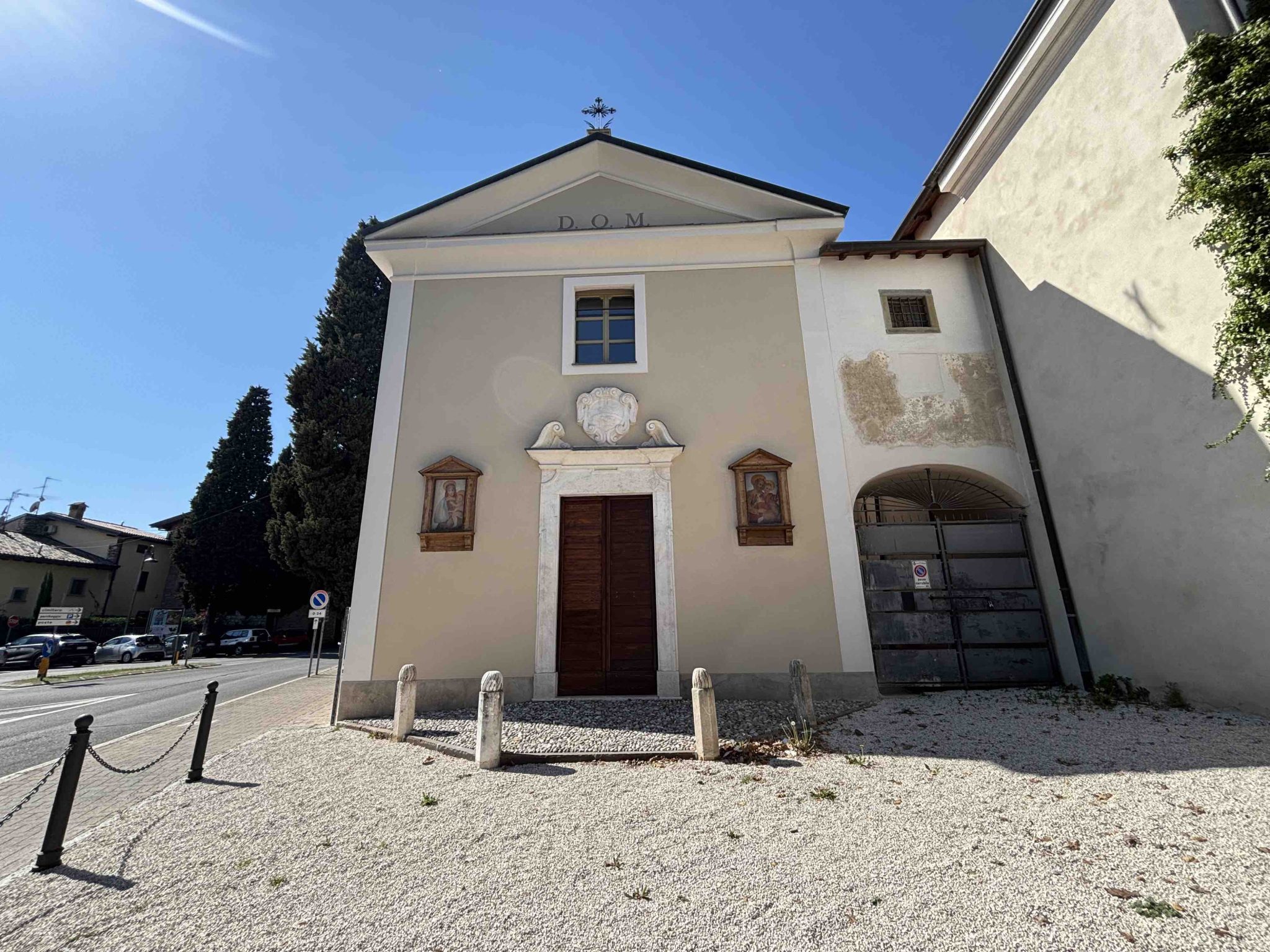
Situated at the junction of Via Roma and Via Rimembranze, the church first appears in historical records in a document from 1413, when a chaplaincy was established there. A partially legible inscription suggests that it was consecrated in 1457.
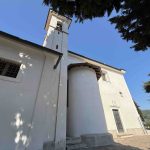
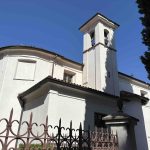
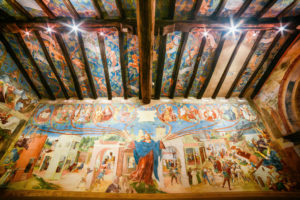
Originally, the apse faced east: a number of 15th-century frescoes, rediscovered in 1953, can still be seen there. One of them bears a funerary inscription in Latin hexameter, dated 1473. Some graffiti, though difficult to decipher, appears to date from the 14th century. In 1727, the holder of the lucrative benefice, Canon Giuseppe Albani—whose coat of arms is preserved above the main door—in agreement with Count Giuseppe Mosconi, who had his palace adjacent to the church, obtained the necessary permits to reverse its orientation. In place of the high altar, a doorway was erected, above which a balustrade was placed, with a passageway to the neighbouring palace (all at the expense of the frescoes); the bell tower was built to the side of the sacristy; and an altarpiece depicting the martyrdom of the church’s patron, Saint Bartholomew the Apostle, by an anonymous painter of the mid-17th century (it was long erroneously attributed to the sixteenth-century artist Francesco Terzi). Above the chancel are two oval paintings depicting Tobias with the angel and Job, set within original gilded frames of fine workmanship. An unknown eighteenth-century painter created a Holy Family, rendered in very delicate tones. On the right-hand wall stands the funerary monument to the noblewoman Silvia Adelasio Mosconi Celati, who, by her will of 1854, founded the orphanage, which was opened in 1863 by the Sisters of Saints Bartolomea Capitanio and Vincenza Gerosa, known as the Sisters of Maria Bambina.
It is to them that we owe the statue of Maria Bambina, placed in a niche specially carved out of the left-hand wall. On the façade are two paintings, protected by grilles, depicting the Virgin Mary and Saint Joseph.