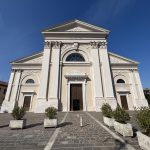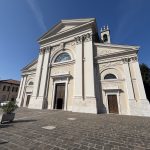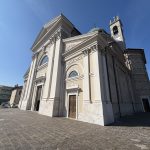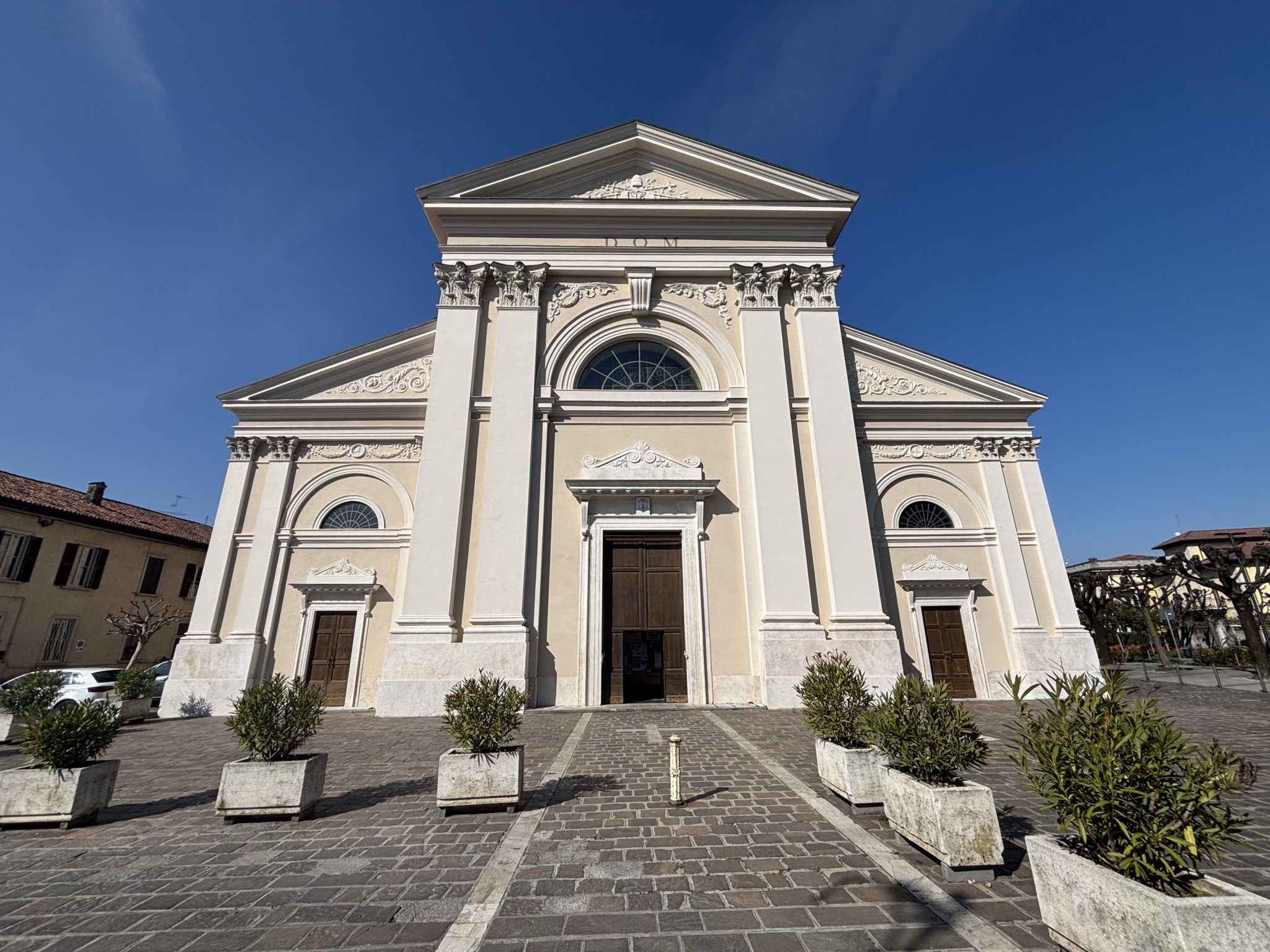
The church of San Pietro, first mentioned in 1230, had an apse facing east and a façade adjoining the parish house. Pastoral visits of the time describe the old church with the main chapel frescoed by Giovanni Battista Castelli and that of San Rocco by Lorenzo Lotto. In 1680, the parish priest Francesco Sonzogni enlarged the church, reversing its orientation.
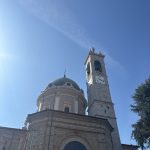
This second church came to cover the space from the apse to the entire dome, destroying the precious frescoes. Four statues by the Brescian artist Sante Callegari were placed on the façade: Saint Peter and Saint Paul – now on the roof, marking the original dimensions of the second church – and Saint Roch and Saint Sebastian, placed inside. In the second half of the nineteenth century, based on a design by Antonio Preda, work began on the third church, in the basilica style, which was opened for worship in 1886 and consecrated in 1906 by Monsignor Giacomo Maria Rodini Tedeschi, in the presence of Don Angelo Roncalli. A sculpture of Saint Peter was placed on the bell tower, created on a monumental scale almost certainly by Giosuè Meli (Luzzana 1816, Rome 1893). The current sculpture is a copy reinstalled in 1991 after the original was shattered by lightning. Only the head of the original remains, now in the rectory garden. Adjacent to the parish church, on the site of the old cemetery, stands the Church of Our Lady of Lourdes, built in the 1920s under the supervision of the provost, Don Giuseppe Mojoli. Inside the church are frescoes by Ponziano Loverini (1845–1929), Pietro Servalli (1883–1973) and Vittorio Manini (1888–1974), the fine pulpit from 1906 by Giacomo Rocchi, and works by Antonio Balestra (1666–1740), Sebastiano Ricci (1659–1734), Francesco Bergametti (1825–1883), Antonio Moscheni (1854–1905) and Francesco Capella (1711–1784).
PARISH HOUSE
The present parish house is a listed building, whilst no trace remains of the old one. We know of its existence from 16th-century pastoral visits, which describe the façade of the old church adjoining the parish house.
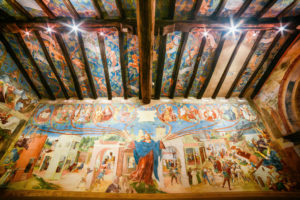
The present vicarage dates from the 17th century. The ceiling of the reception room was embellished in 1691 with a magnificent fresco by Antonio Cifrondi (Clusone 1656, Brescia 1730) depicting the fall of Simon Magus. Perhaps due to the heavy financial burden of adorning the church with major works of art, in 1703 Bishop Luigi Ruzini noted that the parish priest’s house was instead furnished with modest furnishings; whilst in 1931 the parish priest, Don Giuseppe Mojoli, “completely renovated the rectory, adding a rustic house with a portico, four rooms, two attics, a large cellar for pressing grapes and four flowerbeds in the garden”. The entrance to the rectory leads into a hall with a glass door opening onto the garden; several rooms used as an office lead to the archive, which features a ceiling frescoed in the 19th century with decorative geometric designs and walls entirely covered by large canvases: among these is the Madonna and Child with Saints by Paolo Zimengoli (1700–1724). From here, one enters the large reception hall featuring a fresco by Antonio Cifrondi. The walls are adorned with 17th– and 18th-century paintings. On the upper floor, a bright corridor leads to a hall decorated with frescoes from the first half of the 19th century and furnished with various works of art. Among the numerous rooms is one reserved for the Bishop during pastoral visits.
Text by Luisa Gaiardelli and Carlo Pinessi