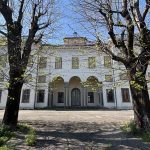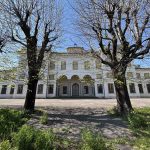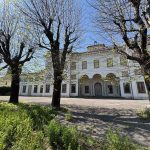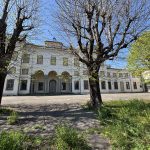
For three centuries, the Mosconi family had lived in that spot at the entrance to the Strada district.
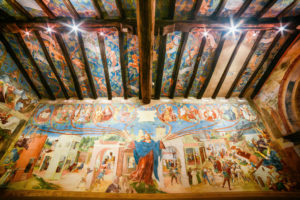
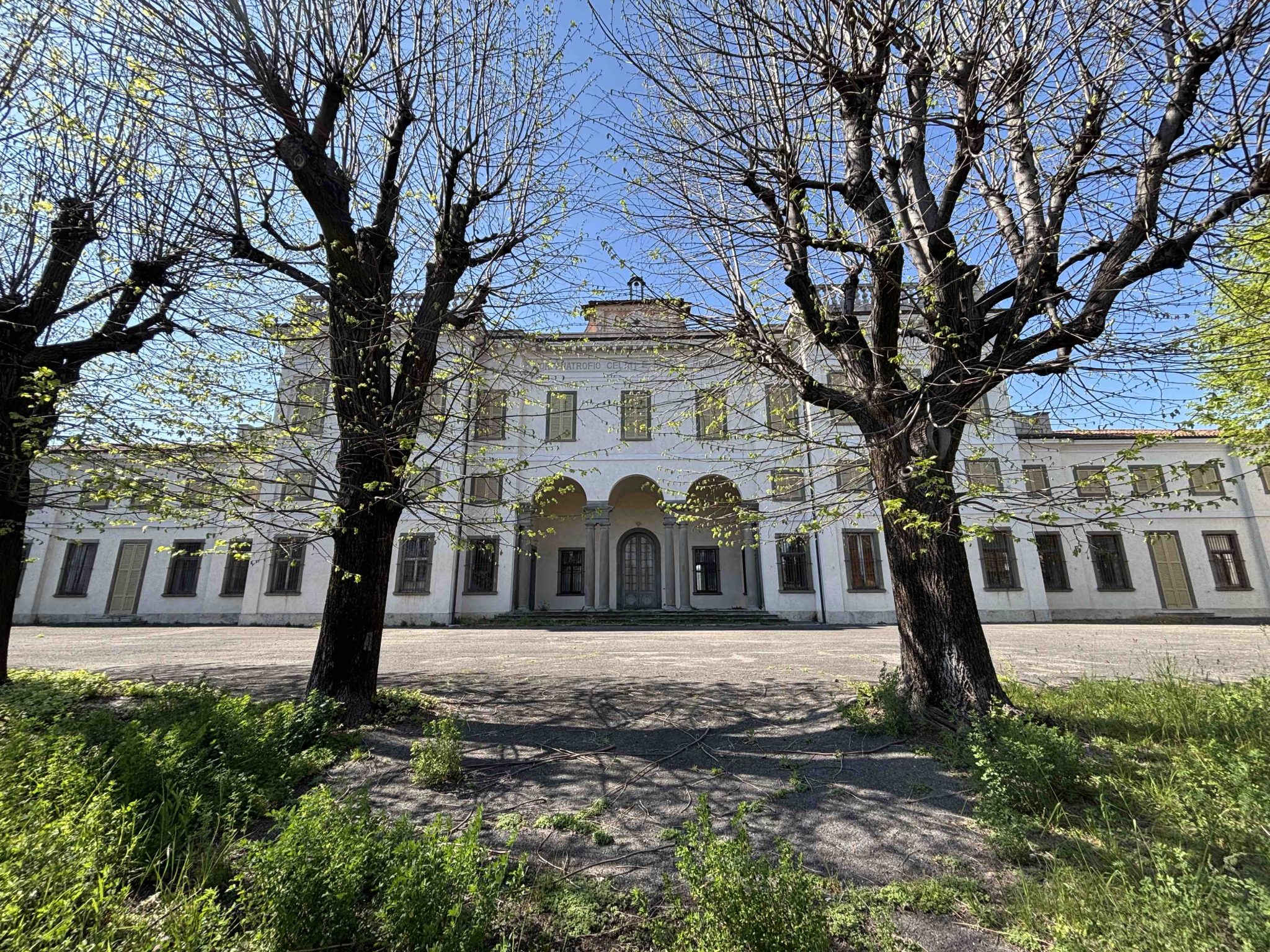
In 1774, Count Giovanni Mosconi had several old houses demolished to build his new imposing palace in the Neoclassical style. On the ground floor, a fresco from the second half of the 18th century depicts various stages of the construction. A central portico with three openings, separated by Tuscan columns, shelters the three large stone-framed doors, which appear to reveal an earlier 17th-century structure.
The central door leads into a large hall with a frescoed vault depicting the Judgement of Paris, the work of the Milanese artist Federico Ferrario (Milan, 1714–1802), who is also likely to have painted some of the frescoes in other rooms. To the left of the portico, between two iconic columns, an arched doorway opens onto a large neoclassical staircase with three flights, decorated with stucco work. The stuccoes in the various rooms, however, date from 1836 and are the work of Battista Salvatoni (Gandino 1909 – ?), commissioned by the noblewoman Silvia Adelasio Mosconi Celati, the last descendant of the family. On the first floor, the long gallery is decorated with late 18th-century perspective figures. From the courtyard in front, two wide avenues running perpendicular to each other led: one towards the east, with a gate opening near the avenue leading to the thermal baths; the other, 300 metres long, led to another gate which today borders the hospital. From 1866, the building was first used as an orphanage and later as a primary school: these functions entailed radical alterations to certain internal parts of the building.
Text by Luisa Gaiardelli and Carlo Pinessi