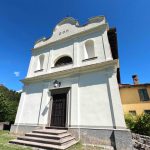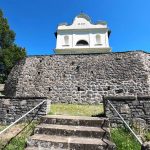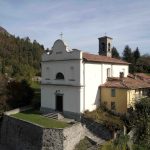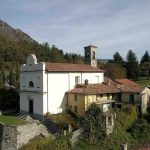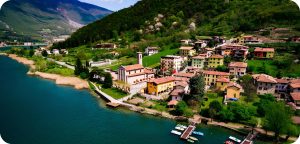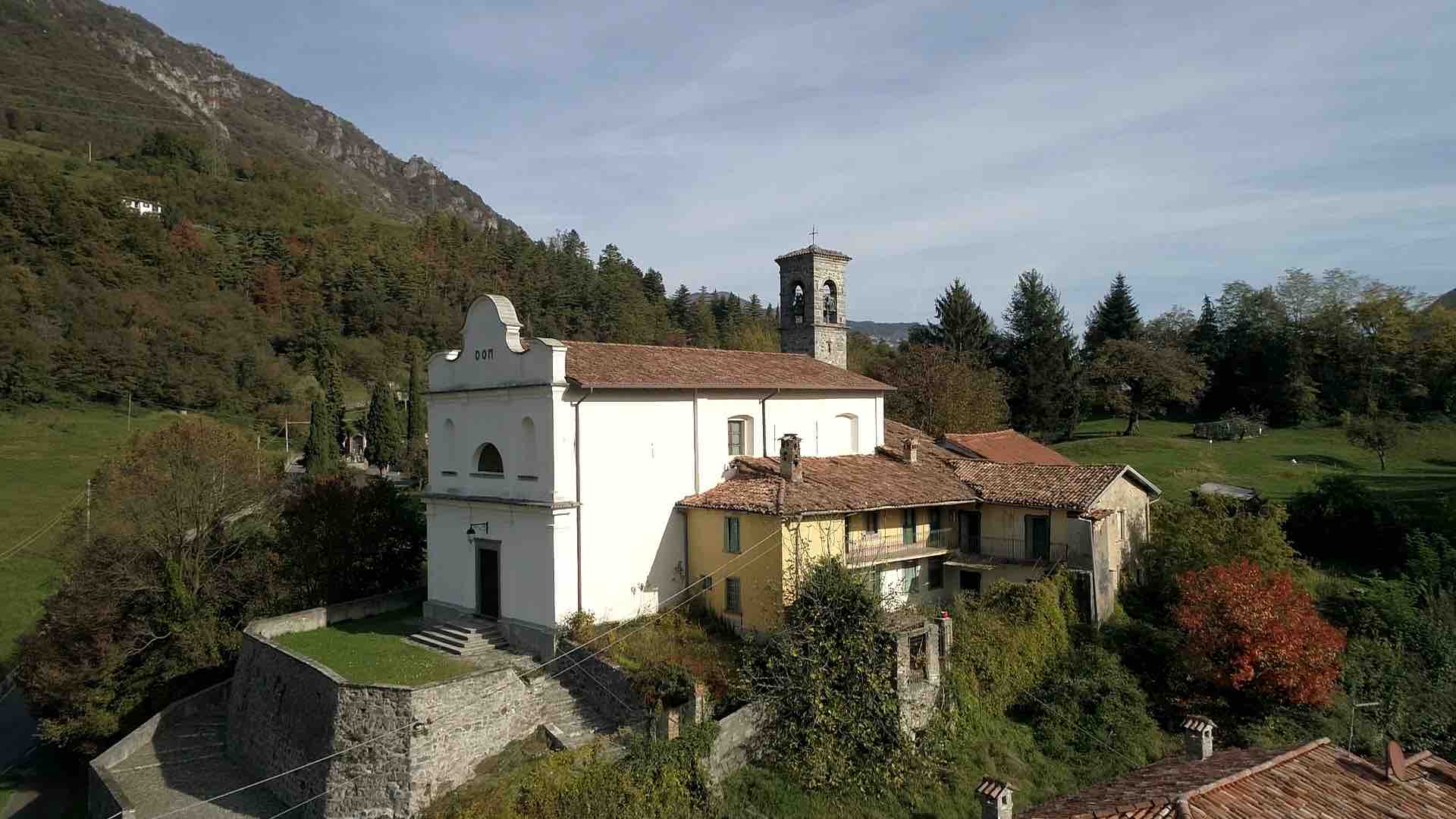
Situated in the upper part of the hamlet of Rova, the church is reached via a picturesque flight of steps leading to the churchyard, introducing visitors to a building of elegant simplicity.
The façade, harmonious in its proportions, is organised into three orders. In the first order, marked by four pilasters that divide the façade into three sections, the central entrance portal, crafted from Serena stone, opens up. The second order follows the same layout: a central semicircular window illuminates the nave, whilst two niches adorn the side sections. Crowning the whole, the third order features a refined, curved broken pediment that lends movement and dynamism to the structure.
The interior consists of a single nave divided into five bays, creating an intimate and harmonious space. On either side of the entrance door, set against the counter-façade, are two wooden confessionals. The baptismal font is situated in the first bay on the left; the third bay features the side entrance, whilst the statue of the Madonna stands on the opposite side. The fifth bay, raised three steps above the nave, houses two altars.
The eye is drawn to the elegant barrel vaults that cover the nave and lead towards the chancel, raised a further two steps. Square in plan, it culminates in a semicircular apse that enhances the liturgical area. A side door connects the chancel to the sacristy. Natural light filters through four rectangular windows above the cornice and two tall semicircular windows in the choir, helping to create a bright and intimate atmosphere.
HISTORICAL NOTES:
– 1560–1675: In the summary of churches in the Diocese of Bergamo, drawn up in 1667 by the chancellor Marenzi, there is mention of the Church of the Holy Trinity in Rova as a subsidiary of the parish of Esmate, but spiritually subject to the church of Solto (Marenzi 1666–1667). According to Pagnoni, this church in the district of Rova, founded as early as 1560, was separated from the parishes of Solto and Esmate and canonically established as an independent parish by a decree dated 1 July 1675 issued by Bishop Daniele Giustiniani (Pagnoni 1992);
– 18th–19th centuries: reports from pastoral visits indicate that from the early 1700s to the late 1800s, the interior of the church was as follows: a brick floor; a chancel with two steps without balustrades, without a wall-mounted bench or sideboard; a semi-hexagonal apse with two benches for sitting and two for kneeling. On the left-hand side, a door leading to the bell tower. The small square sacristy, with a tuff ceiling, had served as a catechism classroom since 1712;
– 1845–1848: in the past, the church was surrounded by a steep lawn enclosed by a wall. To create a level surface, it was decided to build retaining walls and parapets using Sarnico stone;
– 1894–1908: during this period, the church was extended. In addition, all the decorations were redone by the artist Alfredo Tosti of Rome. All that remains of the original early church today are the outer walls of the apse and part of those of the nave;
– 1909–1910: the sacristy was enlarged (16 x 8 metres).
Source: “Le chiese delle diocesi italiane” https://chieseitaliane.chiesacattolica.it/chieseitaliane/index.jsp