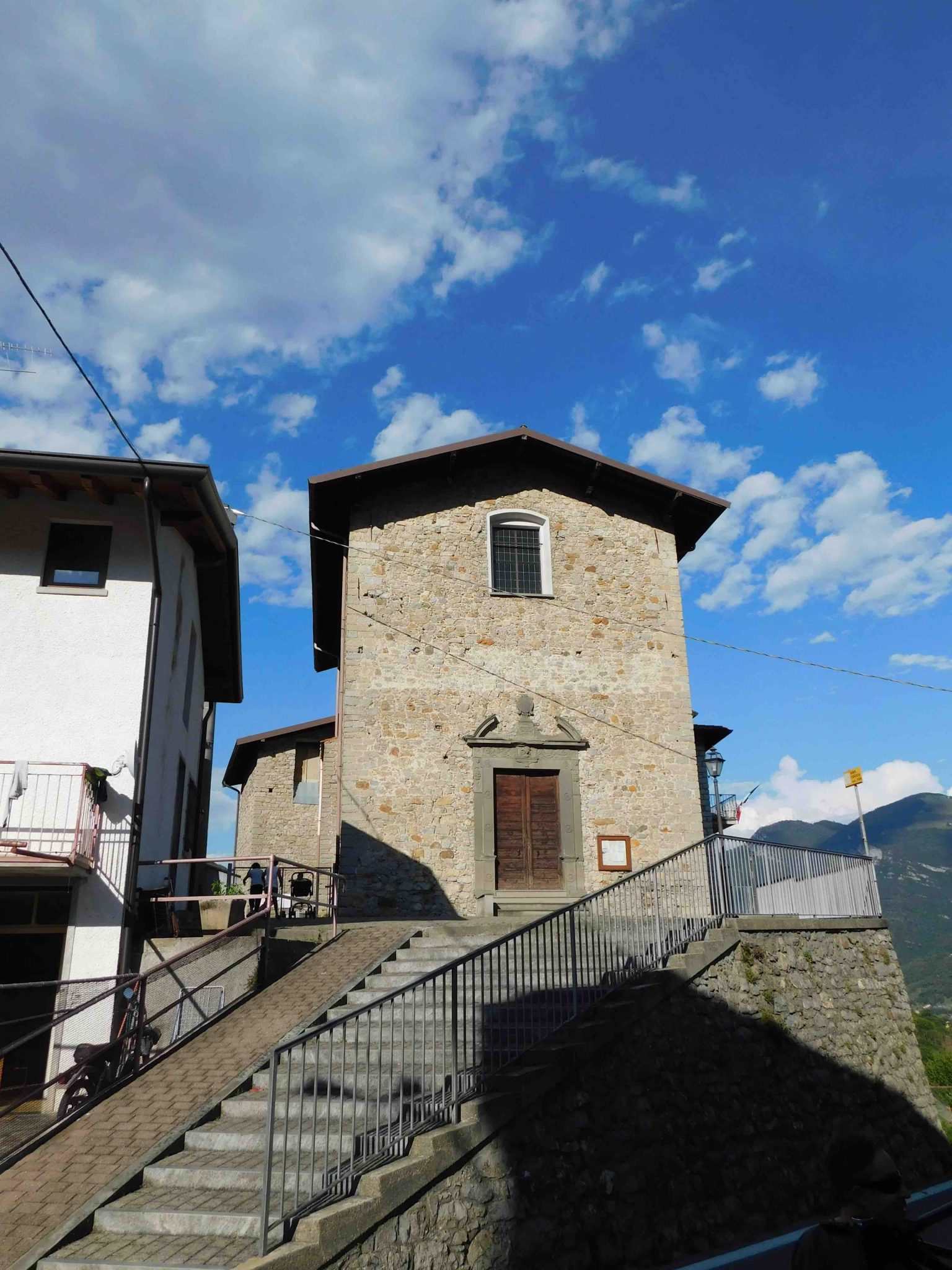
Perched on a rocky outcrop, the Church of San Rocco dominates the landscape and welcomes visitors with a picturesque ascent: from the main road, a comfortable flight of steps leads up to the small churchyard, as if preparing one for entry into a place suspended in time.
The south-west-facing façade is striking for its vertical sweep: tall and austere, devoid of plaster and ornamentation, it allows the stone to speak for itself. Only the sandstone portal breaks this simplicity, embellished with jambs and lintels decorated with rosettes and garlands of fruit and vegetables, as a subtle reference to life and abundance.
Inside, the space unfolds as a single nave, punctuated by elegant stucco pilasters that divide it into five bays, each with its own function. The first two welcome the visitor with simplicity, whilst the third houses a secondary entrance on the right-hand side. The fourth bay contains two smaller chapels: on the left, the chapel dedicated to Our Lady of the Holy Rosary, with a simple marble altar; on the right, the Chapel of the Holy Family, featuring an altar finished in stucco. The final bay leads to the entrances to the sacristy and the adjacent house.
Above the pilasters runs a continuous entablature, embellished with a frieze and cornice, upon which rests a round arch that harmoniously envelops the entire space. The chancel, raised slightly by two steps, is divided into two bays and covered by a barrel vault, completing the architecture of the sacred space with balance and solemnity.
HISTORICAL NOTES:
– 15th–16th centuries: the present church stands on the ruins of a castle. An opening, now bricked up, on the exterior of the bell tower – formerly the castle’s tower – features smoothed edges that date it to the 14th century;
– 1575: according to the records of St Charles Borromeo’s Apostolic Visit, the church already existed and was described as a very dark church; furthermore, it is said that the castle was converted into a church following a vow;
– 1629–17th century: six large windows were opened to illuminate the interior of the church; furthermore, it was established as a public oratory;
– 1668–1677: on the tympanum of the curved, broken portal, a decoration in the shape of a monstrance bears the carved date MDCLXXIIIX (1677). This date refers to major renovation works. In fact, Pietro Nicoli da Casale, in the years 1668–1669, provided several beech trees to make a hundred planks for the roof of the church of S. Rocco;
– 1840–1854: restoration work was carried out on the church and the bell tower was raised. In addition, three bells were installed, blessed by Bishop Speranza on 28 December 1854;
– 1953: a new room for the chaplain of St Rocco was built adjacent to the church.
Source: “Le chiese delle diocesi italiane” https://chieseitaliane.chiesacattolica.it/chieseitaliane/index.jsp