In 1575, during one of his pastoral visits, San Carlo Borromeo found himself before a church that was already richly decorated with frescoes and equipped with two altars, a sign of a vibrant and devout community.
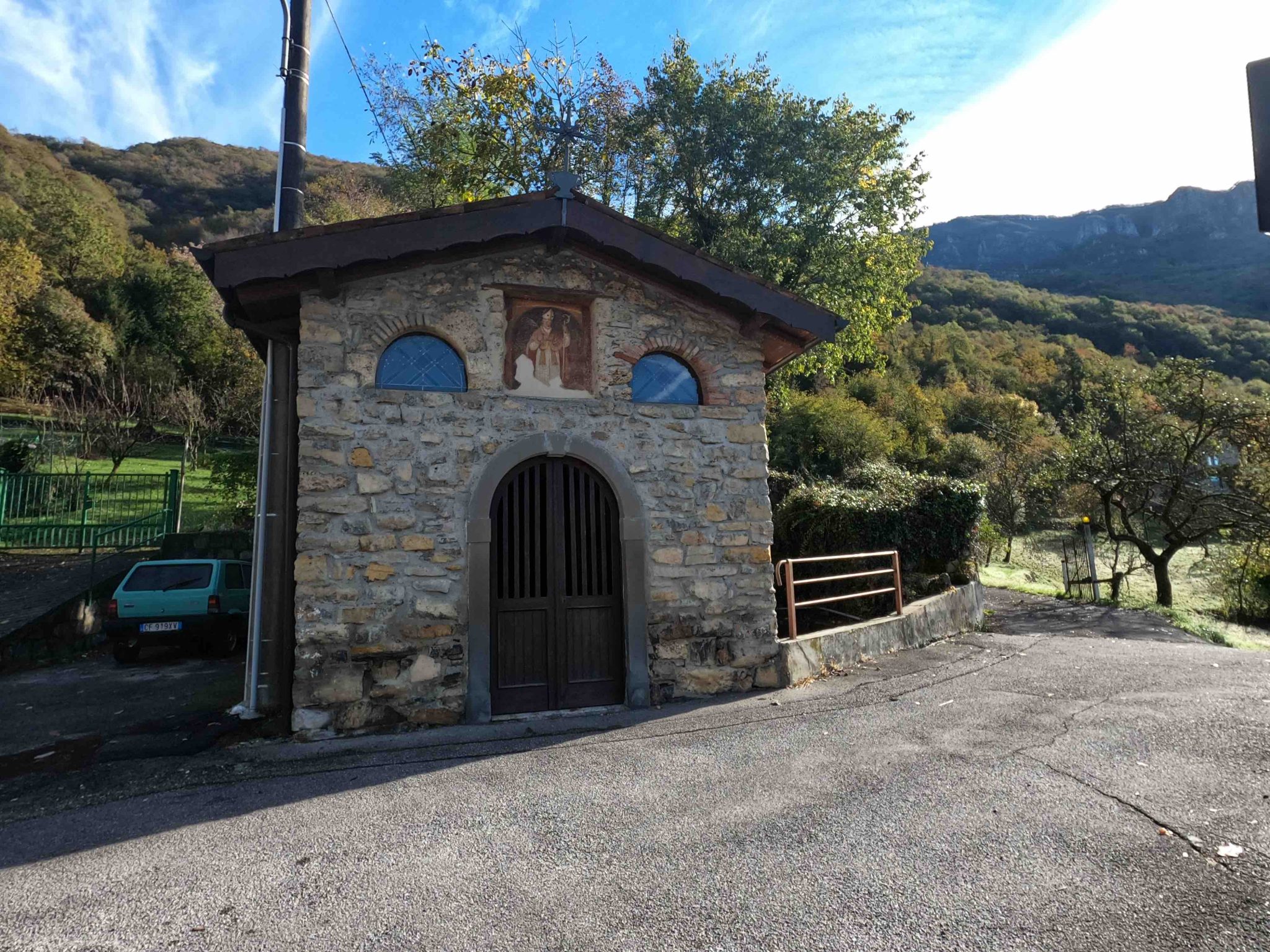
The building, compact in size and lacking a churchyard, faces directly onto the street, as if to welcome passers-by without any distance between them. The main façade, like the others, is characterised by exposed stone block masonry, which gives the whole structure a solid and authentic appearance. At the centre is a round-arched entrance in sandstone, closed by a wooden door divided into two parts: the lower section is solid, whilst the upper section, punctuated by vertical openings, offers a glimpse of the interior, arousing curiosity and inviting visitors to enter.
Above the entrance stands the fresco of San Donato Martire, a silent presence that seems to watch over the church and those who approach it. On either side, two small arched windows filter the light, helping to create a cosy and evocative atmosphere inside.
Once inside, the interior confirms the simple yet charming character of the exterior: the exposed stone walls continue to define the space, interrupted only by the plastered chancel, which stands out both visually and symbolically. The nave, a single-aisled rectangular space, is covered by a barrel vault that guides the eye towards the chancel, which is slightly raised by a step and just a little narrower. Here too, the barrel vault continues, creating continuity and harmony in a space that is unadorned yet rich in atmosphere.
HISTORICAL NOTES:
– 1575: during his pastoral visit, St Charles Borromeo found the church frescoed and equipped with two altars;
– 17th – 1836: following St Charles Borromeo’s visit, the church was abandoned until 1836 when, on the initiative of a group of parishioners, it was restored;
– 19th century: following the restoration of the building, episcopal approval was also granted, and consequently the small church was reopened for worship and dedicated to Saint Mauro.
Source: “Le chiese delle diocesi Italiane”, https://chieseitaliane.chiesacattolica.it/chieseitaliane/index.jsp